


Too Big to Police? The Issues Arising in Antitrust Enforcement
- University of Bristol Commercial Awareness Society

- Apr 12
- 4 min read
By Joshua Dark
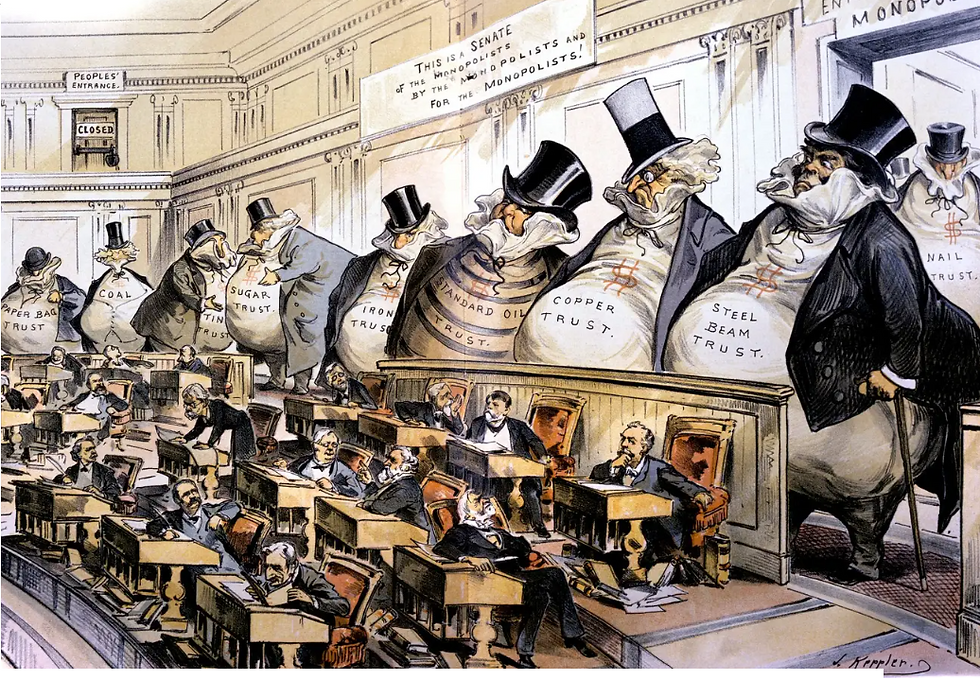
Competition law has long aimed to prevent companies growing in power from abusing their market dominance. The rise in high-profile mergers in recent years have increasingly tested the boundaries of antitrust enforcement. A clear example is the recent United States v. Google LLC (2024) case, which examined Google’s potential monopoly on internet searches and search advertising, focusing on its search engine's default status on various devices. While the ruling that this constituted a violation of antitrust laws was expected, this case nonetheless signals an important trend towards market consolidation .
The core issue is that companies seem more willing than ever to pursue aggressive expansion strategies in competitive markets, ostensibly unafraid of potential regulatory intervention. One could argue that regulation is now reactive rather than preventive. To demonstrate this, consider Amazon, undoubtedly the largest online marketplace. In 2023 (US), and 2025 (UK), claims have been initiated, but is this not too late to curb its market dominance? Whilst the Competition and Markets Authority (CMA) is investigating Amazon and the Competition Appeal Tribunal has cleared a multi-billion-pound lawsuit against them on charges of hiding the products of third-party sellers under in the shadow of its own Amazon-owned products, this all feels too reactive. A slap on the wrist, so to speak, against a giant; the £2.7 billion suit is inconsequential for a global giant. The correct approach, in my view, would have been taxing their profits to hinder growth, or alternatively limiting the acquisitions a company can perform over a set period given how Amazon has acquired over 30 companies in the last two decades.
Now, all that can be said is that these companies hold too much influence in society and are, to most, a reliable resource. I think I find myself in the majority when I say Amazon’s delivery service is used weekly in my household.
The Persistence of Megadeals
In spite of the suits against Amazon and Google, the market is replete with controversial megadeals in various industries. For example, Microsoft’s $69 billion deal, marking a massive shift in the technology sector, faced challenges from regulators who feared it would allow Microsoft to dominate cloud gaming. However, this merger was ultimately approved subject to certain conditions. To name a few, major titles in the gaming industry were to remain accessible on rival software, and 10-year free licensing was bestowed to competition like NVIDIA to prevent Microsoft from having sole ownership of various games (a monopoly). At the very least, we can confidently say that the CMA was taking a preventative approach, but was this sufficient, or is it simply another case of reactive lawsuits in the making? Another interpretation of this merger is that it is the typical case of corporations willingly pursuing mergers that may raise serious concerns because they know that, after minor concessions have been imposed, the CMA will renege on any harsher restrictions they desired (substantiate). Thereby, future monopolies are built with small concessions that will realistically do nothing.
A similar dynamic can be seen in the proposed $110 billion merger between Warner Bros. and Paramount. If approved, Paramount would undoubtedly gain a monopoly in the streaming and entertainment markets. According to Reuters, the vote will be held on the 23rd of April, so one should keep an eye out to see what criticism comes from the European Competition Authorities and the CMA. The mere fact that such a deal could go through highlights the increasing domination of markets by a few global players – perhaps even more shocking is that such deals would have been thought unthinkable as an exception, let alone as commonplace deals.
Declining Merger Enforcement
Several factors could have led to an environment in which companies can grow and grow without efficient restriction, with one prominent factor being the lack of outright blocking of mergers. The CMA appears unwilling to directly block mergers at all as of late; for the first time since 2017, not a single transaction was prohibited outright in 2025. As a matter of fact, Dechert reports that there has been a historically low investigation of mergers. These figures do not necessarily mean that antitrust regulations are becoming weaker, but the statistics do strengthen such a perception.
On the other hand, it would be inaccurate to suggest antitrust law is entirely ineffective. The UK is proposing radical new reforms to competition law. For example, a key reform concerns CMA decision-making; they plan to remove the independent panel that currently makes the final decisions, cutting down on the bureaucracy by granting the CMA Board a larger role. This should equally address transparency issues by making it clear who to hold responsible for failures to regulate companies. However, a new issue comes with this in that political pressure can be exerted on this government board, as opposed to an independent body. Additionally, the outdated adverse effect on competition’ test for investigating companies will be replaced with a test focused on consumer freedom.
Thus, we can have the same hope for the future of antitrust law in the UK, as a consumer-oriented test would prevent companies like Amazon from forcing their own products onto us, whilst stymying affordable competition.
Modern antitrust laws finds itself in a difficult position. The scale of corporations does arguably immunize them to fines and lawsuits, which, for them, are ultimately symbolic rather than transformative. This issue is certainly most prevalent in digital and technology markets, as they can rapidly grow without facing the brunt of regulation. Most troubling is that these companies keep pursuing mega deals with no fear, evidenced by Paramount’s likely oncoming acquisition, which will irrevocably change the streaming landscape.
Nevertheless, the situation is not entirely bleak. Proposed reforms are in place, but they could be coming too late…


Competition enforcement often becomes more complicated when dominant firms operate across multiple markets at once, because proving harm requires more than identifying size alone. One aspect that also deserves attention is how compliance expectations influence the professionals managing procurement, contracts, and project costs within large organisations. A stronger understanding of competition principles can complement technical expertise gained through quantity surveyor courses uk, especially where commercial decisions intersect with regulatory obligations. Better awareness at the operational level may reduce risks long before enforcement authorities become involved, making compliance a practical business function rather than merely a legal response.